

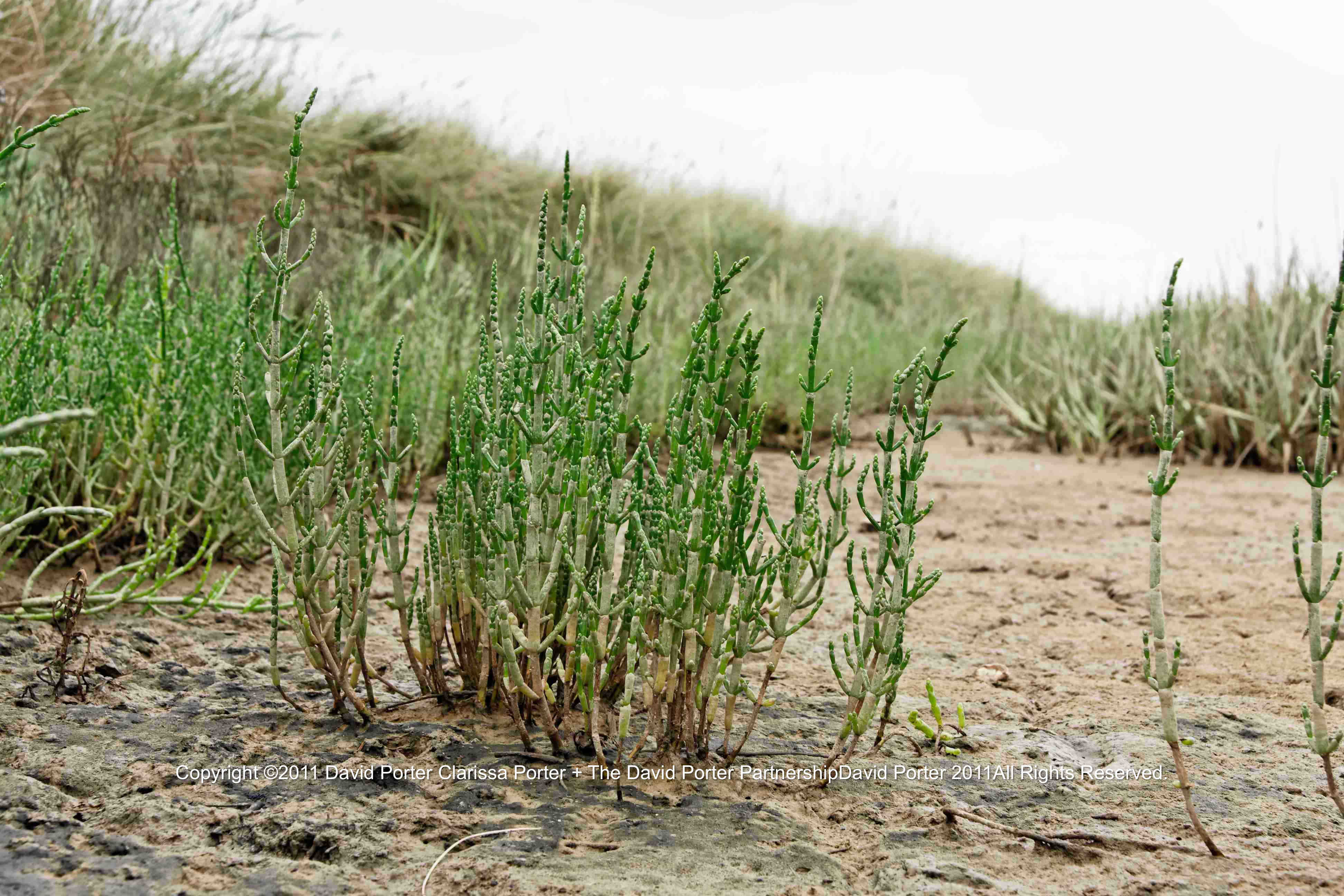
I’m just back from the rickety shack I sometimes call home, on the North Kent marshes. For the last two months I’ve been watching the samphire growing along the creeks of the salt marsh and finally I’ve had the time to gather myself and the three-legged wonder lurcher and get muddy.

Samphire is one of the only two truly indigenous plants of Britain, the other is Sea Kale. Picking Sea Kale is prohibited, but you can collect Samphire so long as you don’t pull it up by the roots. The name comes from a corruption of the French Herb St Pierre, but it is also called ‘poor man’s asparagus’, and ‘glasswort’ because it was used in the 16th Century for the manufacture of glass. In America it is called ‘pickleweed’, and ‘seabean’, and sometimes ‘swampfire’ because in the Autumn it turns a bright red and the marshes seem to be on fire. My samphire is Marsh Samphire, not the Rock Samphire that was once commonplace in London, preserved as a pickle and sold on street corners by boys shouting “Crest Marine”, or “camphire!” Shakespeare after visiting Dover described rock samphire gathering as a ‘dreadful trade’ in King Lear. Children were dangled from ropes tied to their ankles off the tops of cliffs so they could collect the samphire from the rocks below! Women scrambled across cliffs with a crooked stick collecting rock samphire for the London market; Samuel Pepys wrote of receiving a barrel of samphire from the Isle of Wight where it was foraged in huge quantities and sent to London in barrels of seawater, a contemporary writer lamenting that customers of Isle of Wight samphire were ‘buying their sauce with the price of the gatherers lives.’
My local fishmongers, F.C. Soper, sell Samphire all year round, like many of the fresh herbs on sale in supermarkets it comes from Israel. Call me old-fashioned but I prefer my samphire to be picked and collected in season, preferably by me, though I saw lots for sale in Norfolk where they call it ‘samfer’. When I bought some from Furness Fish and Game in Borough Market, I asked the weather-beaten retired fisherman serving where it had come from? Morecambe Bay was the reply. “What’s it taste like?” he said, his expression hinting that you’d have to be mad to eat anything so strange-looking. Samphire has become seriously trendy and ‘cool’, and the fact that you can find it at Borough and in some fishmongers confirms that Jamie, Hugh, and Rick can work their magic on this strange-looking plant which wouldn’t look out of place in Jurassic Park.

“Samphire is for those who want to live a life of total awareness,” says Jan Murre, a samphire gatherer and grower in Holland. I think he means you should try everything once! Thankfully Marsh Samphire is easy to pick, you’ll just need a pair of scissors, a bag, some wellies, and in my case a reluctant lurcher who’d rather be chasing rabbits. So if you haven’t tried samphire, head for the marshes. Look for samphire along the edges of muddy ditches and creeks where the sea washes in and out, better when the tide is out!

Once you’ve found some get snipping. Just snip the top fleshy part, lower down the stem is a woody interior, the top of the plant is the best bit. It’ll carry on growing if you just snip a few inches from the top and leave the rest. Don’t take more than you need, and leave the landscape as you found it. Samphire gathering is recognised as a historical common right, and I’m all for exercising those rights!
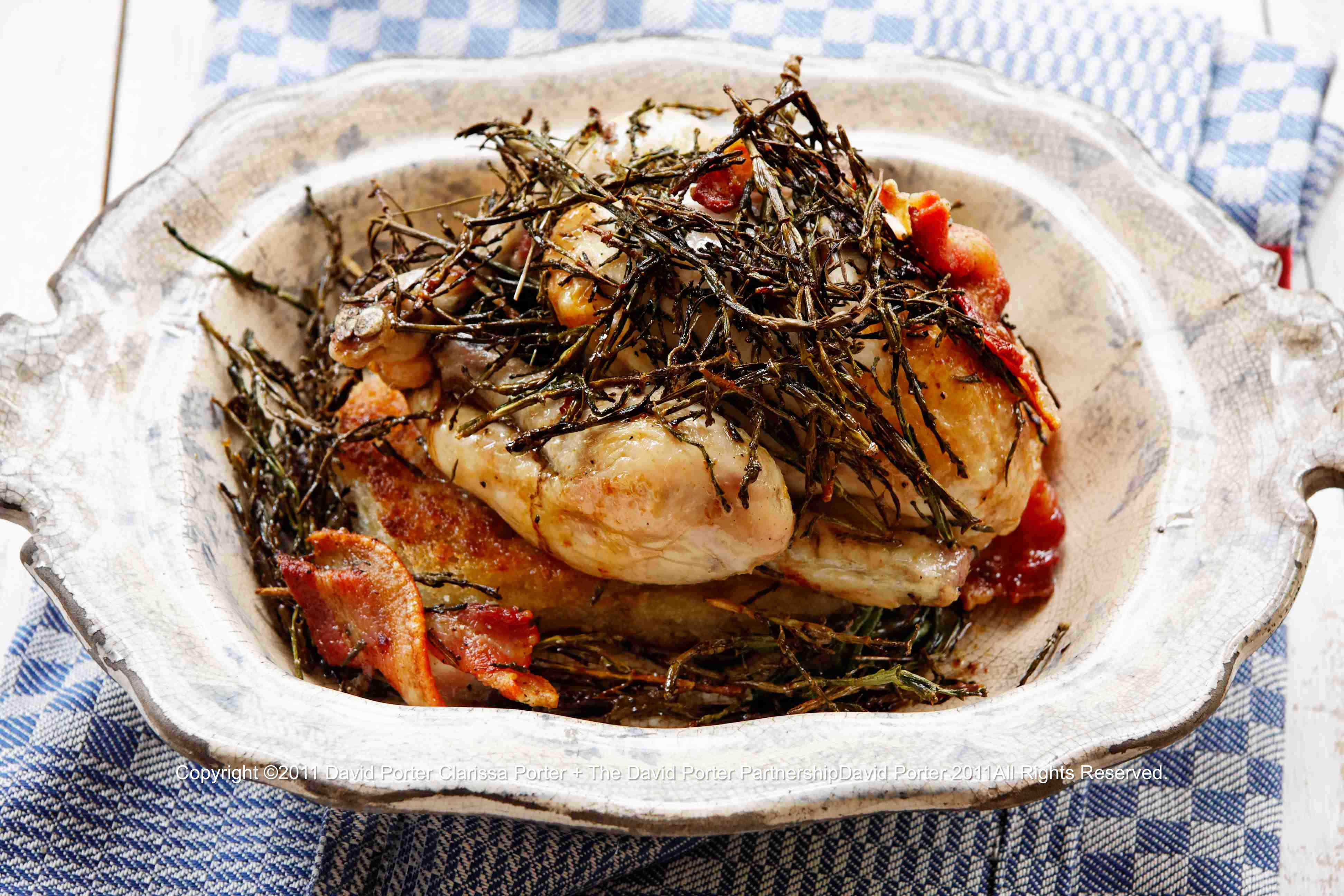
Samphire goes well with just about any fish and meat, especially salt-marsh lamb. The best way to cook samphire is to lightly and quickly boil or steam for not longer than a minute, if that. I like to eat it raw just as I’ve picked it, so the less cooking the better. I’ve found an old recipe dedicated to the actress Sarah Bernhardt. Whether she liked the dish, or it whether it was devised in her honour I don’t know. There are several recipes bearing her name, notably a chocolate meringue confection. This recipe, ‘Larks with Samphire’, has a typically Victorian twist; of course I’m not using larks, you could make this dish with any small bird, a quail or a pigeon or two perhaps, but I’ve chosen to use poussin.
Sarah Bernhardt’s Larks with Samphire
Ingredients:
1 poussin per person
butter
2 handfuls of marsh samphire, washed several times then drained and any woody bits trimmed and removed
1 heaped tablespoon of chopped fatty baacon
1 or 2 rashers of streaky bacon
5 or 6 juniper berries, crushed
1 clove of garlic, crushed
some coarse black pepper
olive oil
1 thick slice of good white bread per bird, with or without crusts
1 measure of gin per person
Method:
Stuff the poussin with a mixture of the chopped bacon, some samphire, the garlic, juniper berries, and a little pepper.
Brush the bird with some olive oil and put into a roasting tin.
Cover the pousssin with a thatch of samphire and then top with the rashers of streaky bacon cut into pieces and scrunched so it twists and curls.
Season again with some more pepper and a drizzle of olive oil.
Roast in a preheated oven at 200C (400F) for 30 to 45 minutes depending on the size of your bird. Testing with a skewer will tell you if it is cooked through: if the juices run clear it is done. The bird may not appear ‘roasted’ and brown because the samphire and bacon will have protected the skin from browning.
While the poussin is cooking take the thick slice of bread and brush with olive oil, then place on a baking sheet in the oven about 8 minutes, maybe less, before the bird is ready. What you’ll have is a large crouton.
When you are ready to serve put the bread on the serving dish, and now the Victorian twist, drizzle with London Gin!
The add a splash of the juices from the roasting tin and carefully place the poussin onto the bread. Pour over a little more of the juices, then it is ready. This is pure theatre, encore Miss Bernhardt!



 Deptford Pudding